
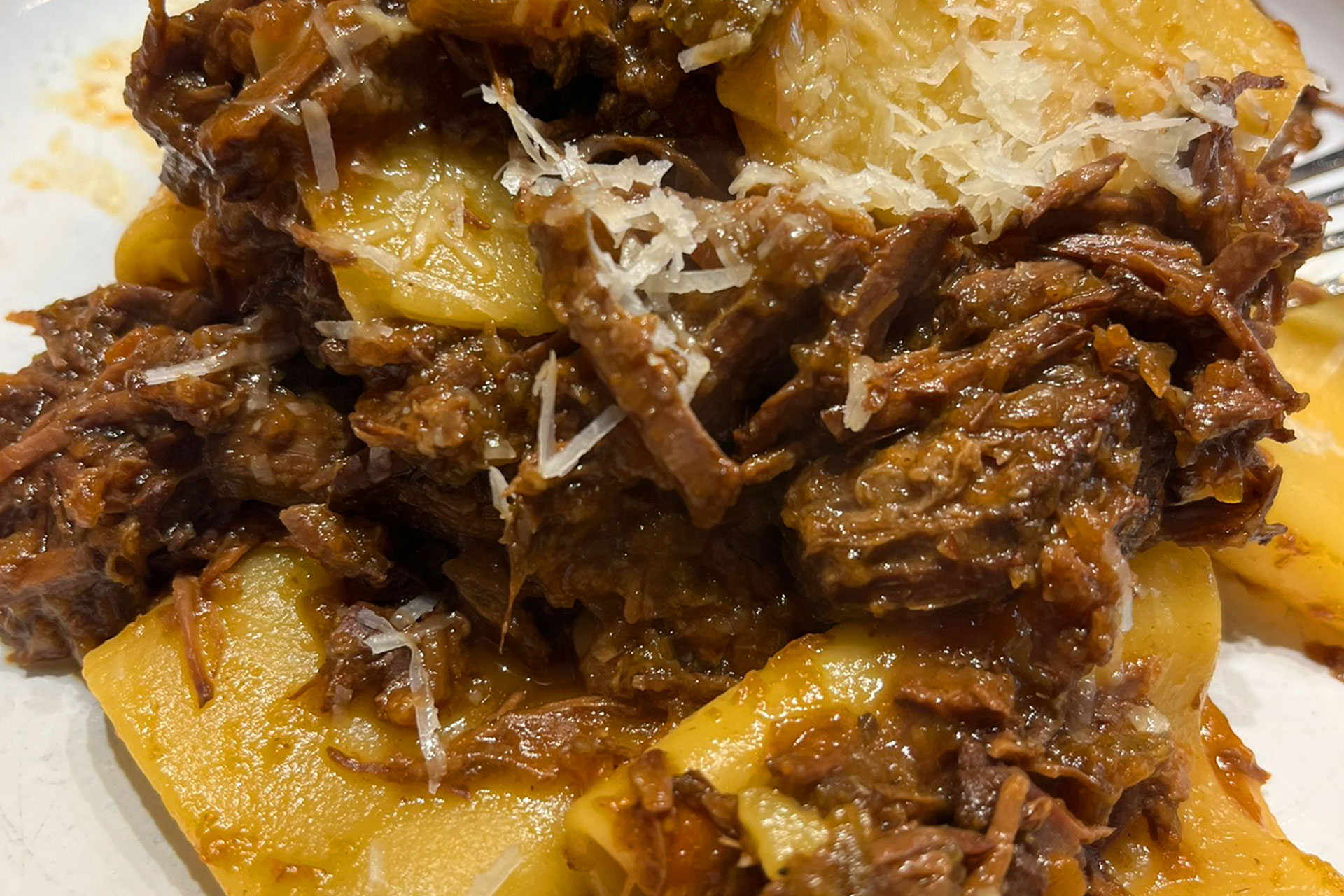
Pasta alla Genovese
I discovered Pasta alla Genovese only a few months ago, yet it has already claimed its place as my go-to Sunday comfort food. It is a dish that demands a sacrifice of tears while slicing mountains of onions and hours of patience while cooking to perfection. After hours of slow-cooking, the onions wrap around tender beef and melt into a sweet, jam-like sauce. When mixed together with pasta and Parmigiano Reggiano, this creates a masterpiece of Italian joy. When that pot hits the table and the steam rises to meet the faces of your favourite people, you realize that every tear and every minute of the wait prove themselves worth it. Pasta alla Genovese is about disparate ingredients merging into a single, soul-warming dish over time. The work is almost entirely in the preparation. Once the pot is on the heat, the time does the rest of the heavy lifting.
6
servings30
minutes4
hours15
minutes4
hours45
minutesIngredients
600 g 600 beef chuck roast
1000 g 1000 yellow / sweet onions
3 3 carrots
2 stalks 2 of celery
200 ml 200 white wine (or veggie stock)
2 2 bay leaves
750 g 750 ziti pasta (paccheri and rigatoni also work)
Parmigiano Reggiano
Directions
- The Onion Mountain: Begin by peeling and slicing onions into thin, delicate strips. You will need a lot of them. Really, a lot. More than you think is reasonable. Don’t be intimidated by the mountain on your cutting board. While the onions seem overwhelming now, they will eventually melt into a sweet, silken gold.
- The Beef & Aromatics: Cut the beef into large, generous chunks. Finely dice your carrots and celery to create a subtle base of flavour.
- Building the base: Place a heavy-bottomed Dutch oven or a large pot over high heat. Add a healthy glug of olive oil and sear the beef chunks until they have developed a deep, golden-brown crust on all sides. Once browned, remove the beef and set it aside to rest.
- Lower the heat to medium. Add the carrots, celery and a small handful of the onions with another splash of olive oil. Sauté for about five minutes, until the vegetables are glassy and fragrant.
- Return the heat to high and add the beef back into the pot. Pour in the wine (or vegetable stock) and bring the liquid to a lively boil. Once bubbling, reduce the heat to its lowest setting.
- Now, tuck the remaining mountain of onions and the bay leaves around the meat. Cover the pot and let it simmer for at least four hours. Stir occasionally.
- A Secret Between Us: If you prefer, you can transfer everything to a Crock-Pot and let it go on "Low" for 8 hours, even overnight. It works beautifully, though we might want to keep that our secret from Italian traditionalists.
- Over time, the onions will turn into a jam-like sauce, and the beef will fall apart at the touch of a fork.
- When ready, bring a large pot of well-salted water to boil and add pasta. Traditionally, this dish calls for ziti pasta, broken by hand into halves. However, Paccheri or Rigatoni are wonderful alternatives, they are excellent at catching the sauce and tend to be a bit more kid-friendly.
- When the pasta is cooked “al dente”, add it – along with a few tablespoons of the starchy pasta water – directly into the sauce. Add a generous amount of Parmigiano Reggiano and mix well until every piece of pasta is glossed in sauce. Plate it up with an extra dusting of cheese and a crack of black pepper.
- I find a glass of bone-dry white wine with a bright, bracing acidity is the perfect partner to balance the intense sweetness of this rich, savoury dish. A Riesling from the rolling hills of the Rheingau region is a personal favourite.
- Buon appetito!
Equipment
- Heavy-bottomed Dutch oven or large pot
- Large pot for the pasta
- Sharp knife
- Chopping board
Notes
- A secret between us: if you prefer, you can transfer everything to a slow cooker and let it go on “Low” for 8 hours, even overnight.
- Paccheri or rigatoni are wonderful alternatives to ziti – they are excellent at catching the sauce and tend to be a bit more kid-friendly.
- I find a glass of bone-dry white wine with a bright acidity is the perfect partner; a Riesling from the Rheingau is a personal favourite.